What Causes ADHD?
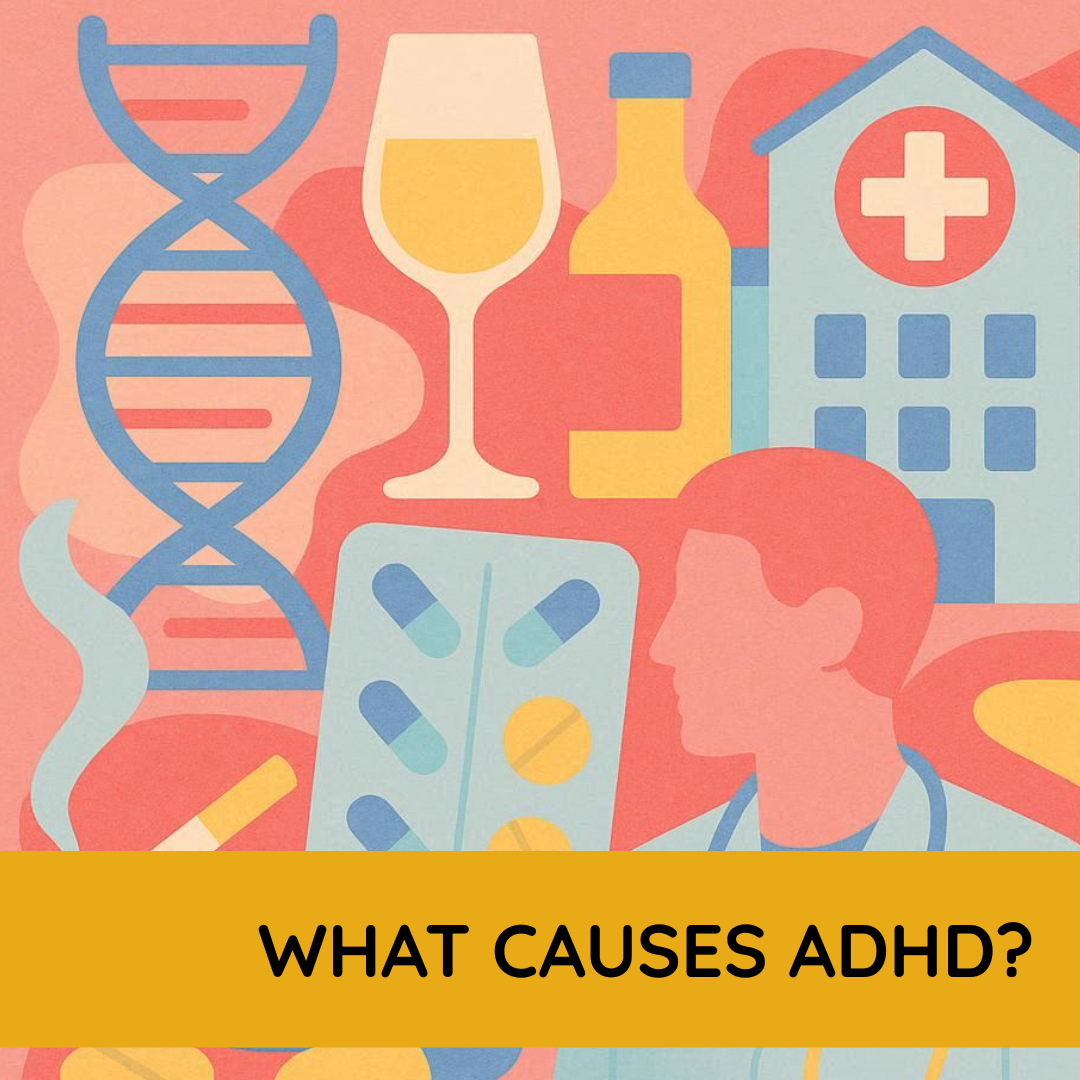
ADHD isn’t caused by one thing. It’s a neurodevelopmental condition that arises from a mix of biology and environment—think “recipe,” not “single ingredient.” Here’s what research says in plain language, plus what doesn’t cause ADHD.
The short version
- ADHD is highly heritable (runs strongly in families) and linked to many small genetic differences—not one “ADHD gene.”
- Family studies show that if a child has ADHD, their siblings or parents are 2–8 times more likely to have it compared with the general population.
- Brain development and communication pathways (especially dopamine and norepinephrine systems) show reliable differences in ADHD.
- Before birth and early-life factors (e.g., prematurity, low birth weight, prenatal alcohol/nicotine exposure) can raise risk, but none are “the” cause on their own.
- Inflammation and immune pathways may play a role for some people—an active area of research.
- Parenting style, sugar, and screen time do not cause ADHD. They can influence behaviour day-to-day, but they are not the root cause.
- One myth that continues to circulate is that vaccines cause ADHD. This is not supported by any scientific evidence. Large-scale studies across many countries have repeatedly shown no link between childhood vaccinations (including MMR) and ADHD.

1) Genetics: why ADHD runs in families
Large reviews show ADHD is polygenic—influenced by many genes, each with small effects. Genome-wide studies identify multiple DNA variations tied to brain signalling and development. Having these variants increases susceptibility, but doesn’t guarantee ADHD—environmental context still matters.
2) Brain development and neurochemistry
Neuroimaging and neurobiology papers consistently report differences in networks that manage attention, impulse control, and timing. The dopamine and norepinephrine systems—key for motivation and focus—are central in ADHD, which is one reason stimulant and non-stimulant medications that modulate these systems help many people.
3) Prenatal and early-life influences
Risk for ADHD is higher, on average, with:
- Prenatal exposures (e.g., nicotine, alcohol, certain medication, maternal infection)
- Pregnancy/birth complications (e.g., prematurity, very low birth weight, traumatic brain injury, )
- Certain early environmental exposures (e.g., lead, air pollution, heavy metals, organophosphates)
These factors don’t cause ADHD by themselves; they nudge a developing brain that may already be genetically susceptible. Most children who experience one of these exposures do not develop ADHD.
4) Inflammation and the immune system (emerging science)
Some studies suggest ADHD can be associated with pro-inflammatory signals and altered immune pathways, potentially affecting brain circuits linked to attention and self-regulation. This line of research is promising but not yet definitive and likely applies to subgroups rather than everyone with ADHD.
5) Sleep, lifestyle, and the environment: important—but not “the cause”
Chronic sleep problems can mimic or amplify ADHD-like symptoms and are common in ADHD—so good sleep assessment is vital. Environmental toxins (like lead) are risk factors, but typical diets (including sugar) and screen time are not established causes. That said, nutrition, routines, and media use can modulate day-to-day functioning.
6) Adults with ADHD: same roots, later recognition
ADHD starts in childhood—even when it’s first recognised in adulthood. Adult-focused reviews echo the same multifactorial causes and highlight that symptoms can be masked or compensated for until life demands outgrow coping strategies. cureus.com
7) Myths & misconceptions
Public beliefs about what “causes” ADHD have long been mixed (and sometimes inaccurate). Modern evidence strongly supports neurodevelopmental origins over moral, motivational, or parenting explanations. Taylor & Francis Online
What this means for families
- You didn’t “cause” your child’s ADHD.
- Understanding the biological underpinnings can guide compassionate, practical supports—sleep hygiene, school accommodations, behavioural strategies, and (when appropriate) evidence-based medications.
- Because ADHD is heterogeneous, the best plan is personalised: right supports, right time.
References (open-access and key reviews)
- Poddar A, Gaddam S, Sonnaila S, Bavaraju VSM, Agrawal S. Unraveling Attention-Deficit/Hyperactivity Disorder Etiology: Current Challenges and Future Directions in Treatment. NeuroSci. 2025;6(2):41. MDPI
- Sapkale B, Sawal A. Attention Deficit Hyperactivity Disorder (ADHD) Causes and Diagnosis in Adults: A Review. Cureus. 2023 Nov;15(11):e49144. cureus.com
- Medically reviewed explainer: What are the causes of ADHD? Biology vs. environment. Medical News Today. (overview of genetic and environmental risk factors). Medical News Today
- Saleh M, et al. Psychopathology of attention deficit/hyperactivity disorder: from an inflammatory perspective. Egyptian Journal of Neurology, Psychiatry and Neurosurgery. 2022. SpringerOpen
- Núñez-Jaramillo L, et al. ADHD: Reviewing the Causes and Evaluating Solutions. Frontiers in Human Neuroscience. 2021. PMCID: PMC7999417. PMC
- Solanto MV. Neurobiology of Attention Deficit/Hyperactivity Disorder. Pediatric Research. (classic review of neurotransmitter and circuit mechanisms). Nature
- Dryer R, et al. Implicit theories of the characteristics and causes of ADHD held by parents and professionals. Australian Psychologist. 2006. Taylor & Francis Online
- Zhang X, et al. Advances in the etiology and neuroimaging of children with ADHD. Frontiers in Pediatrics. 2024.


Leave a Reply